
Spacecraft connections get Adam Savage's Smithsonian treatment
Apollo curator Dr. Teasel Muir-Harmony introduces the APAS-75 docking hardware from the Apollo-Soyuz Test Project.
 Adam Savage’s Tested
Story of
Why this story? The channel's weekly summary: what went up this week, what is drawing views now, and where the channel stands among similar channels.
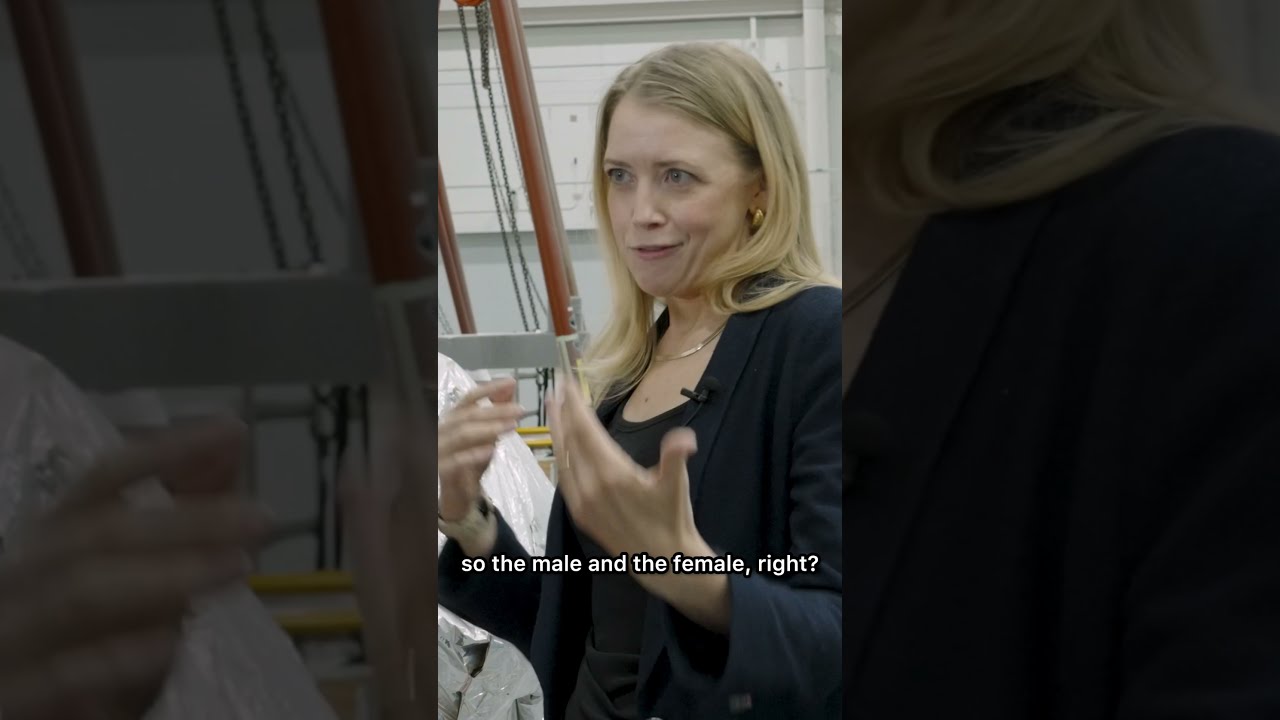 Meet an Androgynous Space Docking Module
A spacecraft connector proved the biggest draw among Adam Savage's Tested uploads, in a week that also found room for aircraft chairs, telescope mirrors and guitar wiring. Eight videos arrived, with "Meet an Androgynous Space Docking Module" reaching about 1.3 million views.
At the Smithsonian's National Air and Space Museum, Apollo curator Dr. Teasel Muir-Harmony introduces Savage to the APAS-75 from the 1975 Apollo-Soyuz Test Project and explains the "androgynous" in its name. Beneath the terminology is an appealing engineering idea: mating interfaces that do not require separate male and female designs. Viewers pick up on the practical advantages of compatible connections, with some discussing how the design's descendants continued in spaceflight.
The museum visit extends to "Humanity's Greatest Engineering Feat?", where curator Samantha Thompson walks Adam through the James Webb Space Telescope Pathfinder. This full-scale engineering model helped test the telescope before launch. Among its details are two beryllium mirrors, one bare and one carrying a microscopically thin gold coating.
Back in the workshop, the newest guitar project is the channel's busiest upload by daily views. Despite "Adam Savage Upgrades His Gibson Les Paul Guitar!" in the title, the description identifies the instrument as a Chinese-made Tokai variant of the Les Paul design. Adam replaces its electronics, then adds an engine-turned finish to two rear panels. The Formlabs printer review is another active draw, moving from miniature-print tests to the engineering inside the machine.
Subscribers held steady across the week, while total viewing reached roughly 5.8 million. Today's viewing is much slower than Tested's usual daily pace, though its weekly total sits behind only Wisdom Pouchannel and Architectural Digest among the nearby DIY channels. For Adam, the latest hands-on assignment is still wonderfully specific: making the back of a guitar worth a closer look.
Published on Trari
Where next?


What viewers say
It really makes the most sense though. Now there's only one design to build and any ship can dock with another with that part.
@xxlocobassistxxSee it on YouTubeWhat's funny is that there are significant advantages of an androgynous docking standard. To the point that NASA is still using an evolution of APAS today.
@pseudotasukiSee it on YouTubeMost electrical connectors are referred as male or female too. Sometimes there are connectors that fit either way with a single part (such as Anderson style battery connectors) that get referred to as Hermaphroditic instead.
@gm_prkr1003See it on YouTube
1 more comment
This is also very smart because that way every craft can dock with another one on each port.
@der.SchtefanSee it on YouTube
Public comments from the video's page on YouTube
 Is this your channel?For the channel's owners and team: a ready picture, text and badge for your audience
Share the story with your audience. Everything is ready:
For an Instagram story or a WhatsApp status
For a community post or your channel's description
For your website

You may use the picture, the badge, and link it to this story.
The videos drawing views on Adam Savage’s Tested right now
 Humanity's Greatest Engineering Feat?245,142 views · 2026-10-12
 The Best Thing Adam Savage Found in Aircraft Salvage217,052 views · 2026-10-09
 $700 Formlabs Form Studio 1 3D Printer Review168,604 views · 2026-10-14
 The Tiny Mistake That Proved How This Movie Prop Was Built157,733 views · 2026-10-11
 Adam Savage Upgrades His Gibson Les Paul Guitar!146,467 views · 2026-10-15
- Channel
- Adam Savage’s Tested
- Subscribers
- 7,290,000
- Channel views, last 7 days
- 5,750,348
- Videos published this week
- 8
- Video published
- October 9, 2026
- Video views so far
- 1,277,591
- Views on its first day
- 370,132
The numbers
Here is how Tested's uploads and audience moved over the week.

💡 Test your knowledge
Which part of the light spectrum is the James Webb Space Telescope primarily designed to observe?
Webb is designed primarily for infrared astronomy, allowing it to study distant galaxies and objects hidden by dust.