
Ben Eater gives his breadboard clock buttons that behave
Part five turns time-setting into a lesson in switch bounce, with an oscilloscope revealing why a simple press can produce extra counts.
 Ben Eater
Story of
Why this story? The channel's weekly summary: what went up this week, what is drawing views now, and where the channel stands among similar channels.
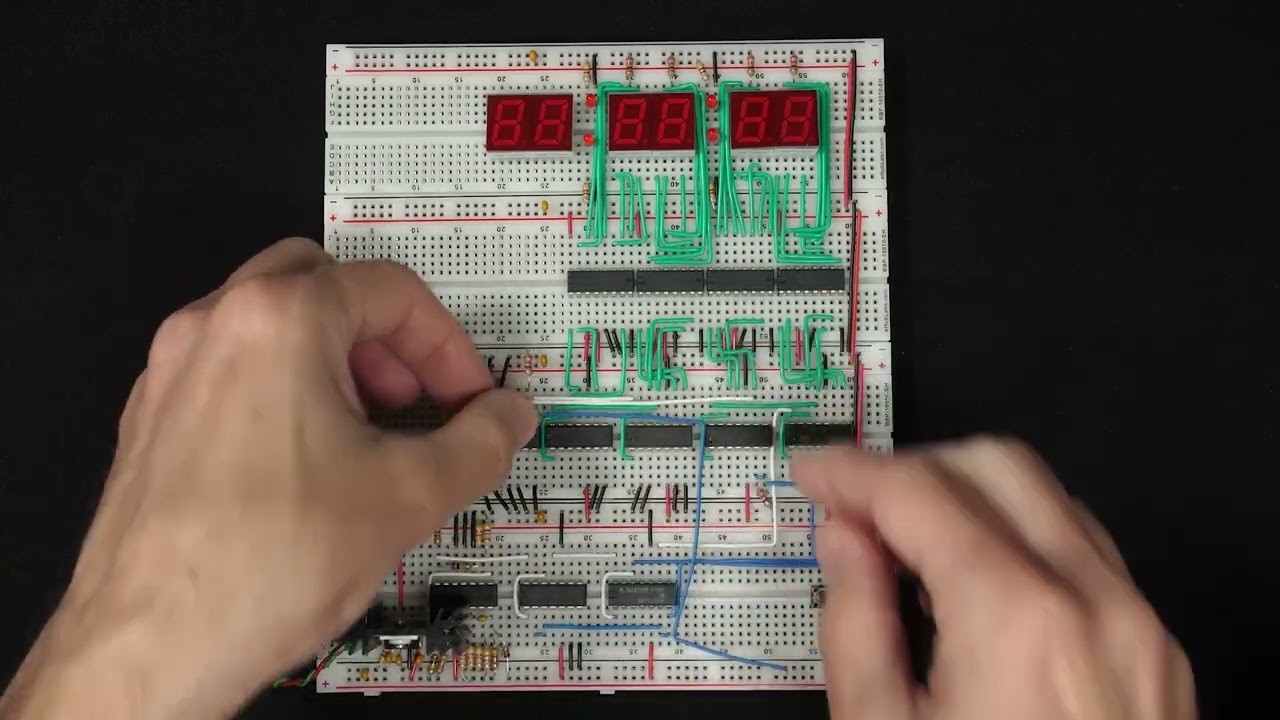 Setting the time on my breadboard clock: Breadboard clock part 5
Things we can learn from the video
Press to jump
- 2:40An XOR gate switches the minutes counter between normal counting and a faster time-setting pulse.
- 4:23Ben installs the XOR chip, grounds unused inputs and adds decoupling capacitors.
- 8:07An older pushbutton produces erratic counts, with mechanical switch bounce visible on the oscilloscope.
- 9:33An RC filter and a comparator with hysteresis clean up the simulated button signal.
- 14:10Ben builds debounce circuitry for the minutes and hours buttons.
- 16:40Testing shows the buttons advancing the clock digits cleanly, without extra counts.
Pressing a button ought to be the easy part of setting a clock. Ben Eater connects an older pushbutton to his breadboard build, and the digits jump erratically. The oscilloscope shows the culprit: the switch's mechanical contacts bounce, turning a single press into several electrical transitions.
That small nuisance supplies the heart of "Setting the time on my breadboard clock: Breadboard clock part 5," his only new upload this week. It has reached roughly 125,000 views, after drawing nearly 100,000 in its first day.
Ben first uses an XOR gate to let the clock's minutes advance faster for setting. Then he works through the messy reality of the button, modeling a solution in a simulator before wiring it onto the board. A filter and a comparator with hysteresis turn the noisy input into a clean signal. By the test, both the minutes and hours buttons advance the digits without skipping.
Viewers are discussing the details that make this a hands-on lesson: the chip pinout diagrams kept in the corner, the correction to the half-speed seconds counter, and their own experiences with troublesome switches. One recalls using cheap Radio Shack buttons precisely because their noisy contacts made useful test equipment.
The new episode is the channel's busiest video right now, with "Let's build a digital clock!" and part four also drawing daily views. Subscribers held steady over the week, while the channel's current daily viewing is more than triple its usual pace. For anyone catching up, part four supplies the minutes-and-seconds circuitry that these new controls finally make adjustable.
Published on Trari
Where next?



What viewers say
I really appreciate the pinout diagrams in the corner of the video whenever you're wiring up a new chip, that's a fantastic addition to the videos
@amconnersSee it on YouTubeOK, I am glad he addressed and fixed the seconds counter incrementing once every two seconds. I thought I was going crazy,
@klchuSee it on YouTubeRadio Shack used to sell cheap red panel mount push buttons. They were pretty terrible and produced a lot of bounce, but were perfect for simulating switch inputs with a lot of noise. I once built a test fixture for something that needed to count the number of times a microswitch was activated over a period of a few seconds - the Radio Shack button really helped me clean up the debounce algorithm in the controller, since it was really a worst case scenario.
@bborkzillaSee it on YouTube
2 more comments
Showing the chip layout whilst you're working makes it so much easy to see
@EmberDartSee it on YouTubeMaking a version of this with Soviet Nixie IN-14 tubes instead of the led displays. 😊
@ckwortonSee it on YouTube
Public comments from the video's page on YouTube
 Is this your channel?For the channel's owners and team: a ready picture, text and badge for your audience
Share the story with your audience. Everything is ready:
For an Instagram story or a WhatsApp status
For a community post or your channel's description
For your website

You may use the picture, the badge, and link it to this story.
The videos drawing views on Ben Eater right now

- Channel
- Ben Eater
- Subscribers
- 1,400,000
- Channel views, last 7 days
- 235,707
- Videos published this week
- 1
- Video published
- October 18, 2026
- Video views so far
- 124,547
- Views on its first day
- 99,809
The numbers
Here is how Ben Eater's clock-building week adds up.

💡 Test your knowledge
When does a two-input XOR gate output a logical high?
Exclusive OR outputs high when exactly one of its two inputs is high.