
California's seawalls can leave beaches without room to move
Cal State LA geologist Josh Kelly explains the sediment trade-off in a CBS LA interview drawing an unusually large audience.
 CBS LA
Story of
Why this story? The video opened at a pace of 61,647 views a day, 18 times a normal first day on this channel (3,437).
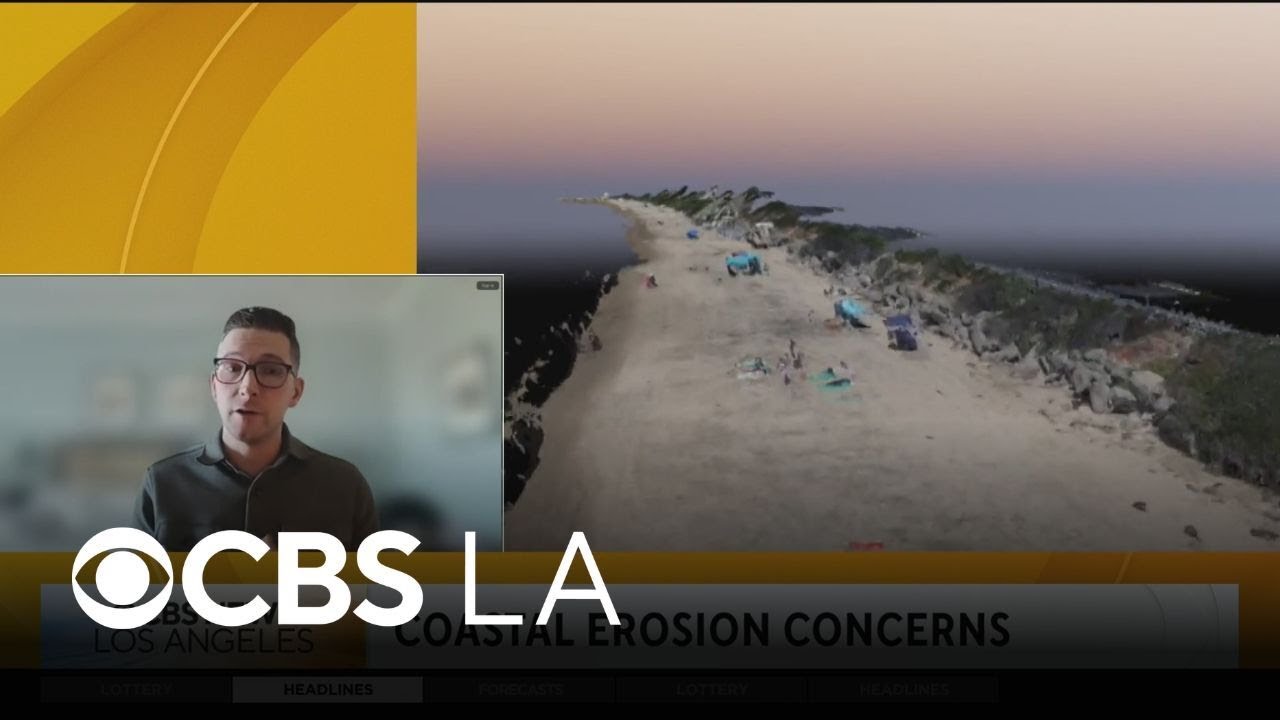 Geology professor discusses California coastal erosion concerns
Things we can learn from the video
Press to jump
- 1:28Kelly explains how warmer water and higher sea levels give waves a higher starting point.
- 2:30Satellite imagery lets researchers track changes in the shoreline.
- 3:00A drone-generated model of Moro Beach helps quantify sediment loss.
- 4:00Cliff erosion replenishes beach sediment; seawalls can block that supply and prevent beaches from migrating inland.
- 5:13Kelly argues that coastal communities must adapt to the water's movement.
A cliff wearing away can look like nothing but a loss. For the beach below, though, that eroding ground can also supply the sand it needs.
That is the complication Dr. Josh Kelly brings to CBS LA's interview about Southern California's coastal erosion concerns. The Cal State LA geology associate professor explains that protecting the shoreline with seawalls can cut off sediment from behind the beach while preventing the beach itself from shifting inland.
"Beaches are very dynamic environments, they're systems of sediment coming in, sediment going out," Kelly says. Holding one boundary in place does not stop the water from moving material elsewhere.
The interview reached roughly 29,000 views in eight hours, already far beyond the channel's usual full-day audience for regular videos. Its subject is immediate, following recent storms, but Kelly also shows how researchers study changes that unfold over longer stretches of time.
He uses satellite imagery to track shoreline shifts and presents a drone-generated model of Moro Beach in Crystal Cove State Park to measure sediment loss. The model turns an apparently fixed landscape into something researchers can compare as it changes.
Kelly also explains how warmer water expands, raising the starting point from which waves reach the shore. His comparison is to someone jumping from a raised block rather than from the ground: the same action starts higher.
For coastal communities, his conclusion is that adaptation is unavoidable. He closes with an adage from a former professor: "The water doesn't care."
Published on Trari
Where next?



 Is this your channel?For the channel's owners and team: a ready picture, text and badge for your audience
Share the story with your audience. Everything is ready:
For an Instagram story or a WhatsApp status
For a community post or your channel's description
For your website

You may use the picture, the badge, and link it to this story.
- Channel
- CBS LA
- Subscribers
- 1,160,000
- Channel views, last 7 days
- 4,711,778
- Channel views, pace per day
- 517,586 (on a normal day: 673,784)
- Video published
- October 23, 2026
- Video views so far
- 28,868 (less than a day online)
- Video views, pace per day
- 61,647
The numbers
The erosion interview has already drawn substantially more views and comments than a typical CBS LA regular video's first day.

💡 Test your knowledge
El Niño develops in which ocean?
El Niño involves unusually warm surface waters in the central and eastern equatorial Pacific.