
A 3D cathedral gives Google's Gemini showcase an architectural test
Tiago Aragona connects Antigravity to Blender, while viewers question the arches, access and cost.
 Google for Developers
Story of
Why this story? The channel's weekly summary: what went up this week, what is drawing views now, and where the channel stands among similar channels.
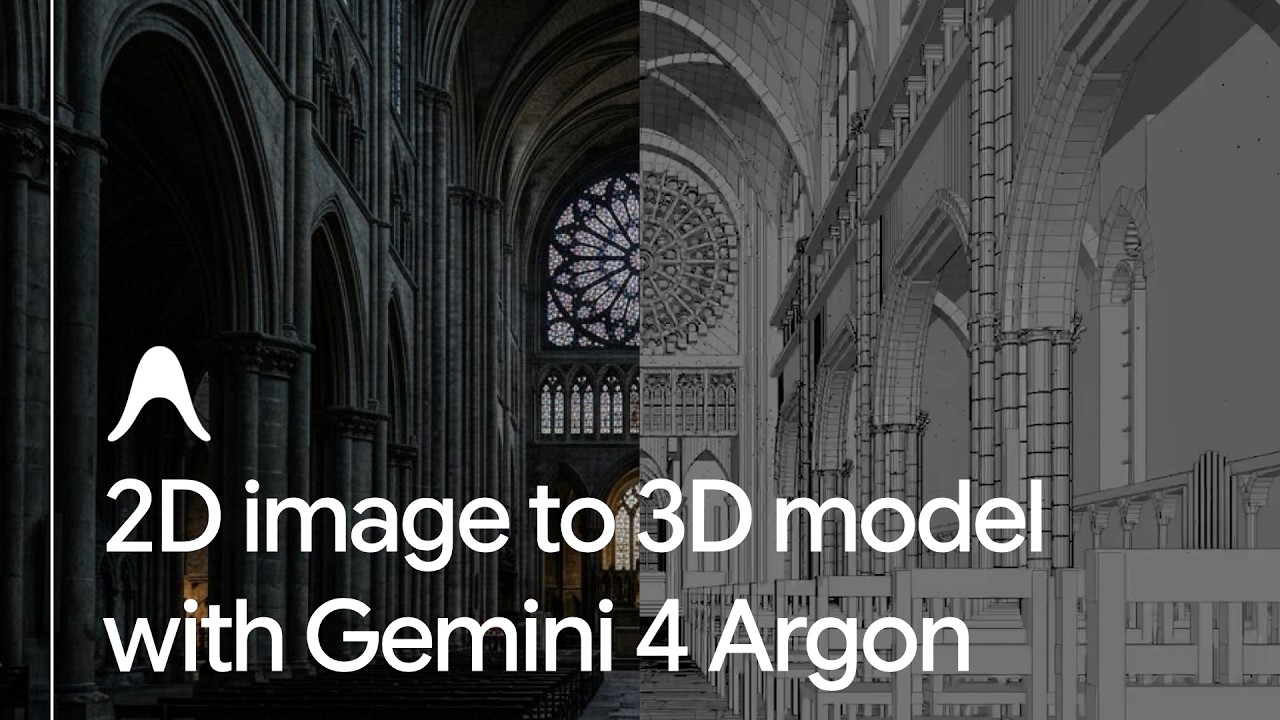 Gemini 4 Argon and Google Antigravity: From 2D concept to 3D cathedral
Turning a flat concept image into a cathedral is an eye-catching assignment. Getting the arches right is another matter, as viewers of Google for Developers' most-watched new upload are quick to point out.
In "Gemini 4 Argon and Google Antigravity: From 2D concept to 3D cathedral," Tiago Aragona demonstrates a connection between Antigravity and Blender through the Model Context Protocol. Google's description says the agent works through repeated iterations to reconstruct the architecture, add column details and arrange volumetric lighting. This is Google's own product demonstration, with the finished scene serving as a showcase for its AI tools.
The video has reached roughly 143,000 views and carries the most daily momentum on the channel. In the comments, viewers compare the arches with the reference image, ask how much the project cost and request access to the model. One wants a fuller tour of the cathedral to better judge the result. The interesting question isn't just whether an image becomes a space, but how faithfully.
Seven uploads made this a busy release week. Logan Kilpatrick hosts a Gemini 4 Argon conversation with Josh Woodward, Melvin Johnson, Sergey Brin and Tulsee Doshi, covering testing, writing quality and validating outputs. Jason Poon's separate Antigravity demonstration includes a pagoda, a racing game and a phone-based 3D world. Those two uploads follow the cathedral in current daily viewing.
Daily channel views are more than twice their usual pace, though subscribers were unchanged over the week. Among nearby technology channels, Google Chrome and Android have also been drawing above-usual daily audiences, while Microsoft is quieter than usual.
The smaller experiments offer a different kind of spectacle: Matias Piña Aguilera uses raw accelerometer data to turn tilts and gestures into browser-based music. After all that virtual architecture, the instrument is something you can move.
Published on Trari
Where next?


What viewers say
How much did it cost, though?
@OlaFosheimGrstadSee it on YouTubeAs far as the last video is concerned, I can do pretty much the same in AE without AI. I'd need to see a full tour of the cathedral to figure out what Argon really did.
@ArgoBeatsSee it on YouTubeCool but can you give us access to the model?
@noname-xt4vtSee it on YouTube
1 more comment
Maaaan. Imagine at some point in time we’ll have enough power to do it all live in real time. Like a computationally expensive ray tracing for max of realism. You wear a VR set or whatever and any image comes alive instantly. One could imagine any world and explore it. We’re becoming the indeed creators of our own worlds ❤
@pavel.strashkinSee it on YouTube
Public comments from the video's page on YouTube
 Is this your channel?For the channel's owners and team: a ready picture, text and badge for your audience
Share the story with your audience. Everything is ready:
For an Instagram story or a WhatsApp status
For a community post or your channel's description
For your website

You may use the picture, the badge, and link it to this story.
The videos drawing views on Google for Developers right now
 Gemini 4 Argon: What’s new and what’s next69,044 views · 2026-10-14
 Gemini 4 Argon in Antigravity25,333 views · 2026-10-15
 Turning raw hardware sensor data into music with Gemini11,916 views · 2026-10-15
 🎵 Turning motion into music with Gemini4,231 views · 2026-10-16
 📖 Explore custom voice narration with Gemini 3.8 Flash TTS3,942 views · 2026-10-15
- Channel
- Google for Developers
- Subscribers
- 2,680,000
- Channel views, last 7 days
- 556,986
- Videos published this week
- 7
- Video published
- October 13, 2026
- Video views so far
- 142,786
- Views on its first day
- 67,241
The numbers
Here is how Google for Developers' viewing and subscriber totals look this week.

💡 Test your knowledge
Which Google co-founder joins the Gemini 4 Argon discussion?
Sergey Brin joins Logan Kilpatrick and Google's other guests in "Gemini 4 Argon: What's new and what's next."